Recent Highlights
This site lists present and past Palomar Scientific and Instrument highlights.
(February 2024) A TRANSIT OF LP791-18C RECENT RESULT FROM JPL USE OF THE PALOMAR 5-M / WIRC
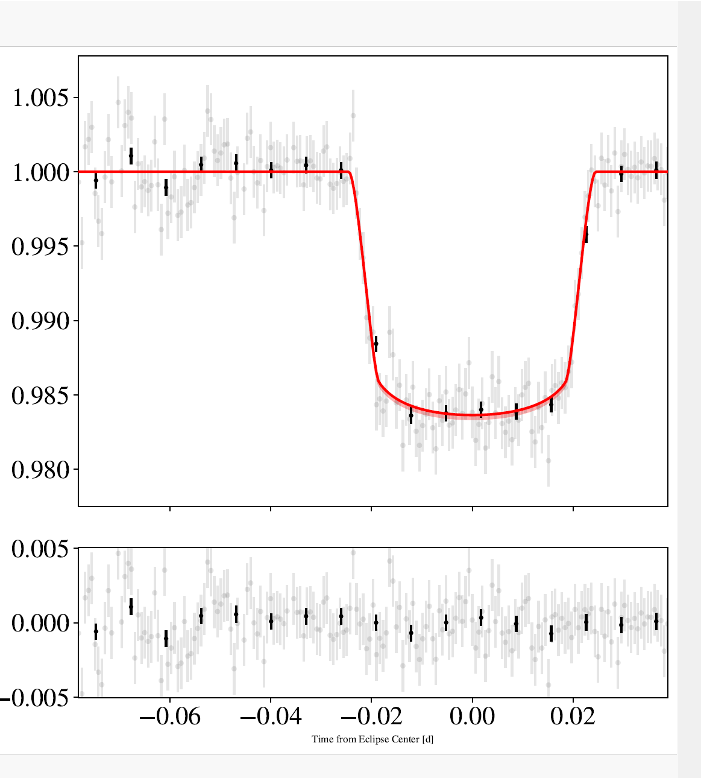 Contributed by Renyu Hu: Here is a transit light curve that we got using the WIRC instrument on January 8, 2024, for LP 791-18c. We've been monitoring TTVs on this sub-Neptune to constrain the mass of the interior planet (LP791-18d) which is an Earth-sized planet with a similar tidal heat flux as Io (based on eccentricity constraints from the TTVs). It could have significant outgassing and is a good JWST target. The TTVs caused on LP791-18c by the tidally heated LP 791-18d are 44 seconds amplitude, and we got a 18 second timing precision with this transit, despite having some clouds and poor seeing on this night. The only other observatory that has been able to break the 20 second timing barrier for this system is Spitzer.
For more information, see https://exoplanetarchive.ipac.caltech.edu/overview/LP%20791-18. There you will learn that the star LP791-18 is a 3500K M6 star- and that planet c has a 5 day period and the transit lasts 1.2 hrs.
Contributed by Renyu Hu: Here is a transit light curve that we got using the WIRC instrument on January 8, 2024, for LP 791-18c. We've been monitoring TTVs on this sub-Neptune to constrain the mass of the interior planet (LP791-18d) which is an Earth-sized planet with a similar tidal heat flux as Io (based on eccentricity constraints from the TTVs). It could have significant outgassing and is a good JWST target. The TTVs caused on LP791-18c by the tidally heated LP 791-18d are 44 seconds amplitude, and we got a 18 second timing precision with this transit, despite having some clouds and poor seeing on this night. The only other observatory that has been able to break the 20 second timing barrier for this system is Spitzer.
For more information, see https://exoplanetarchive.ipac.caltech.edu/overview/LP%20791-18. There you will learn that the star LP791-18 is a 3500K M6 star- and that planet c has a 5 day period and the transit lasts 1.2 hrs.
(September 2023) P3K, PHARO, PARVI and DBSP
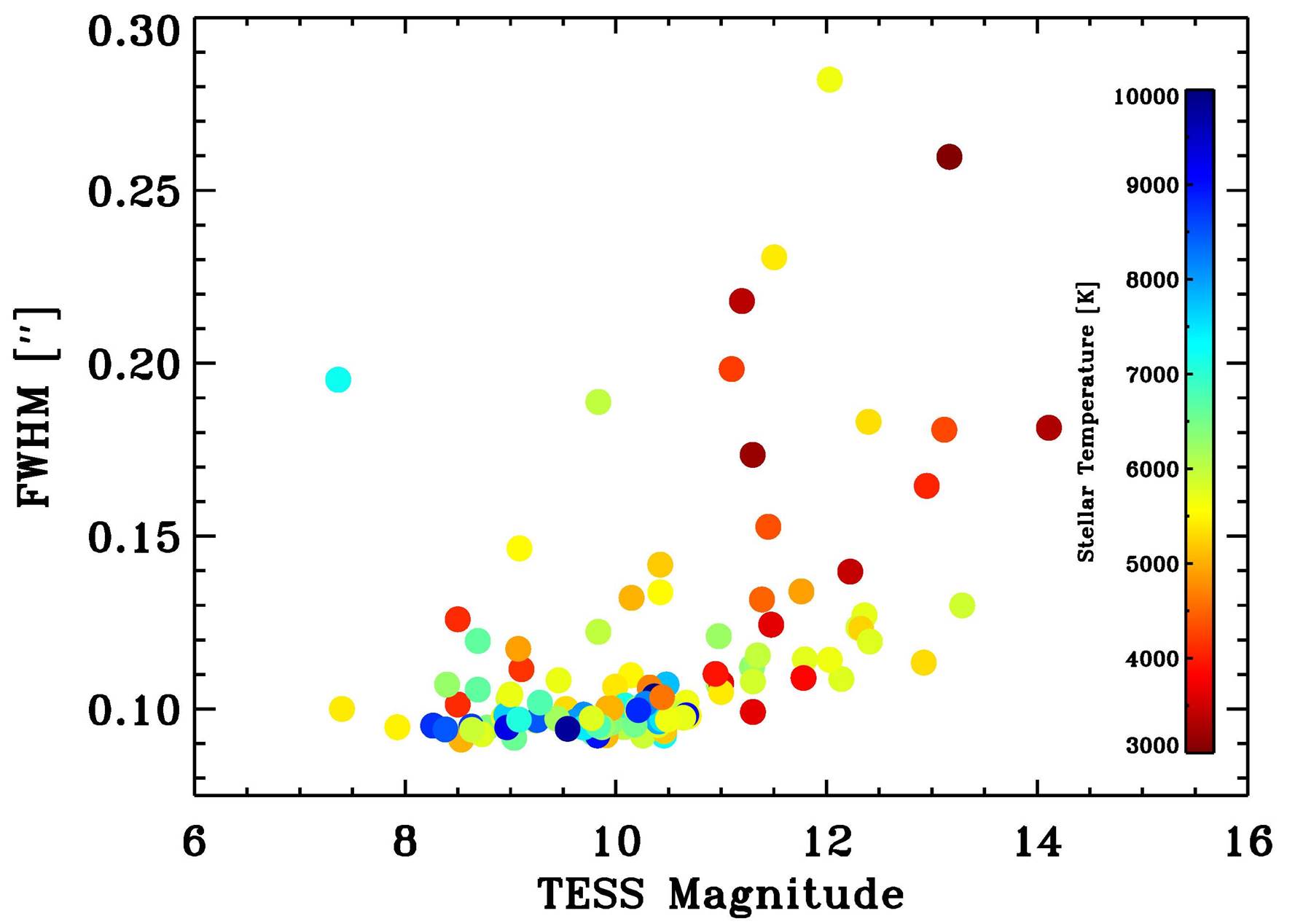
 Figure 1 – Measured PSF at 2um of stars of varying TESS magnitude, using the P3K adaptive optics system and the PHARO camera. Data taken 08/28/2023 by David Ciardi; P3K ably maintained and upgraded by Jenny Roberts. Wavelength/aperture diameter = 0.08 arcsec for the 200-inch at 2um.
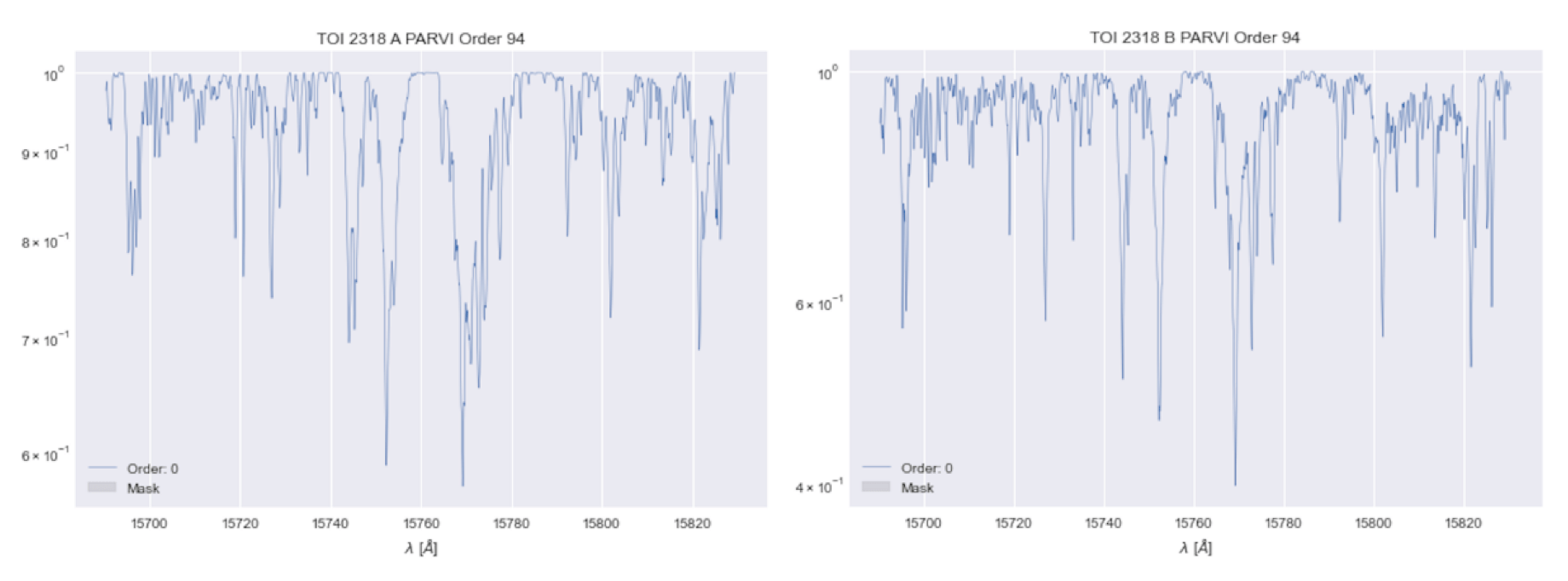 Figure 2 – PARVI spectra of the two K dwarfs in the TOI-2318 system, which are separated by only 0.52". These observations indicated that PARVI will easily isolate the stellar components in the TOI-2121 system, which have a comparable angular separation.
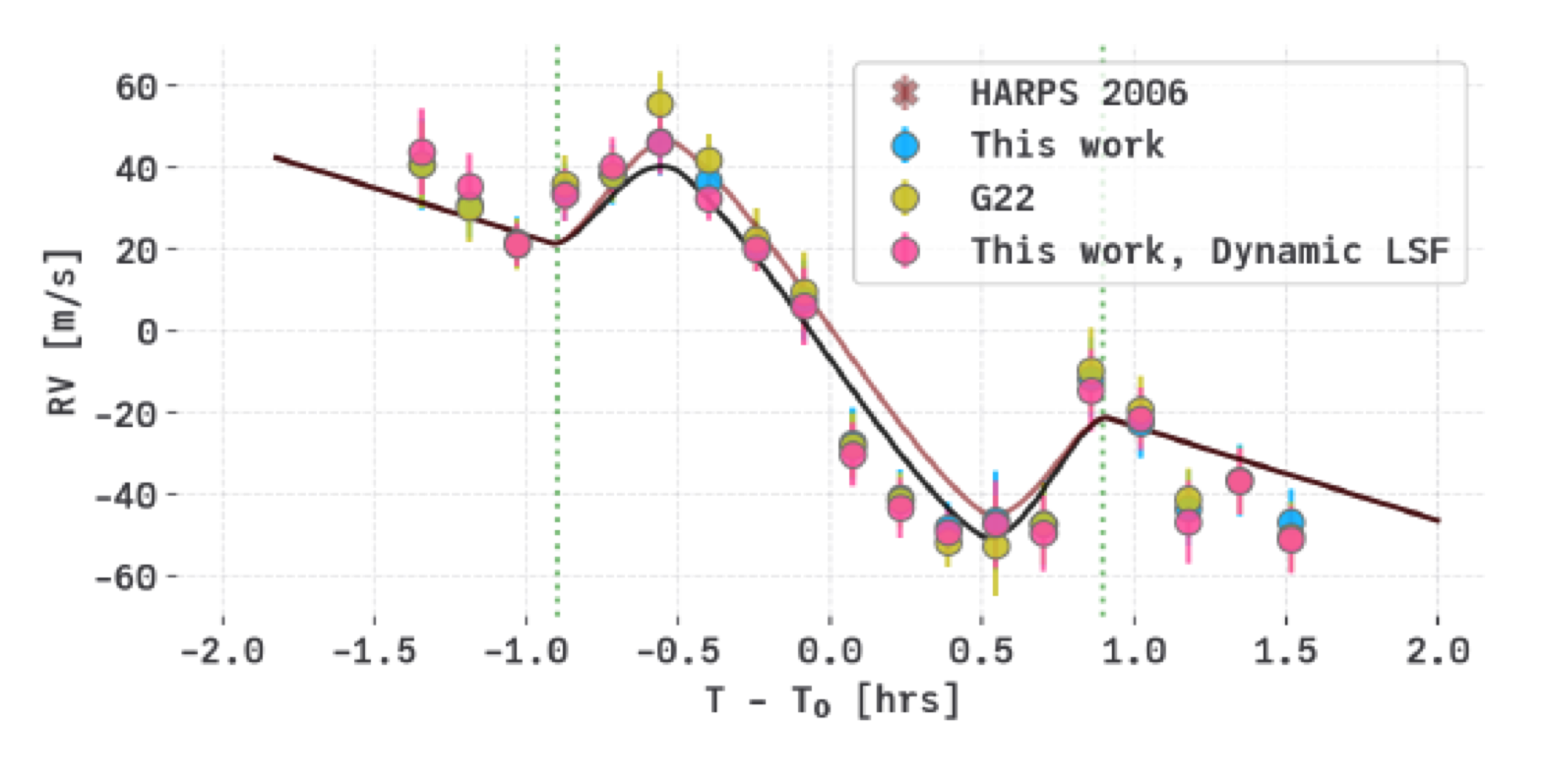 Figure 3 – PARVI data on the Rossiter-McLaughlin effect, which can be used to determine the tilt of an exoplanet’s orbit relative to the rotation axis of the host star, showing vry good agreement of the PARVI data with that from other RV instruments. PARVI is led by Gautam Vashisht, Chas Beichman, and Rebecca Oppenheimer.
 Figure 4 – Images of Neptune obtained with the P3K/PHARO combination and a variety of pass bands showing distinct cloud morphologies at different vertical levels. Data taken by Glenn Orton, Bonnie Buratti, et al.
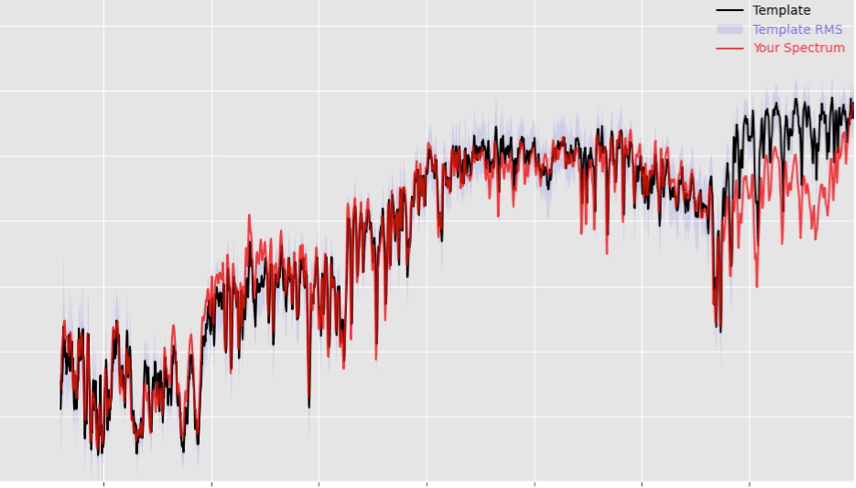 Figure 5 – Spectrum obtained by Jesse Christensen et al of a nearby solar type star, using DBSP to cover wavelengths between 0.37 and 0.5um. This spectrum was obtained as part of a project to develop an atlas of spectra of main sequence stars in support of exoplanet studies.
(16 Dec 2020) Diffraction limited with P3K and PHARO
Diffraction limited stellar image at 2.17 microns of ~11.5th mag star obtained this month with P3K and PHARO at Palomar by David Ciardi.

(Oct 2020) Improved Performance of the Updated P3K System
David Ciardi provided these data showing the performance of the upgraded P3K AO system, based on observations of 120 TESS targets in Nov and Jan at the 5-m telescope. These were all done in 64x mode and the nights were not that great in terms of seeing stability (which is when the AO systems struggles the most). All of these data were taken in the narrowband Br-gamma filter. The instrument measuring the images was the PHARO camera. As you can see, the AO system does very well all the way down to about 11th magnitude (at the diffraction limit); the knee at 11th is not unexpected and is actually pretty tolerable according to David. Note that the P3K+PHARO combination will be in use on the 5-m in early November for the first time since the telescope was shutdown by the pandemic. Then Seth Meeker and his crew get the 8x mode working it will be very interesting to see how the performance improves for fainter stars. As a note, prior to the P3K upgrade, which incorporates an improved Wave Front Sensor, that knee was closer to 9th magnitude. The improved performance will allow David and others to validate many, many candidate exoplanet systems identified by TESS, Kepler, and K2.
Well done David, Seth, and the Palomar crew. It will be great to be on sky again with this unique and powerful capability.
(Fall 2019) Upgraded P3K Adaptive Optics System at Palomar
Improvement in the quality of correction for a given guide star magnitude was recently demonstrated, as shown below, while using the new EMCCD wavefront sensor with its sub-electron read-noise. Compared to the old system, the new system is improved by a factor of ~10x.

The upgrade was led by Seth Meeker. In addition, the images below are courtesy of Dave Ciardi, and done in 64x64 mode using all actuators of the P3K mirror individually.
